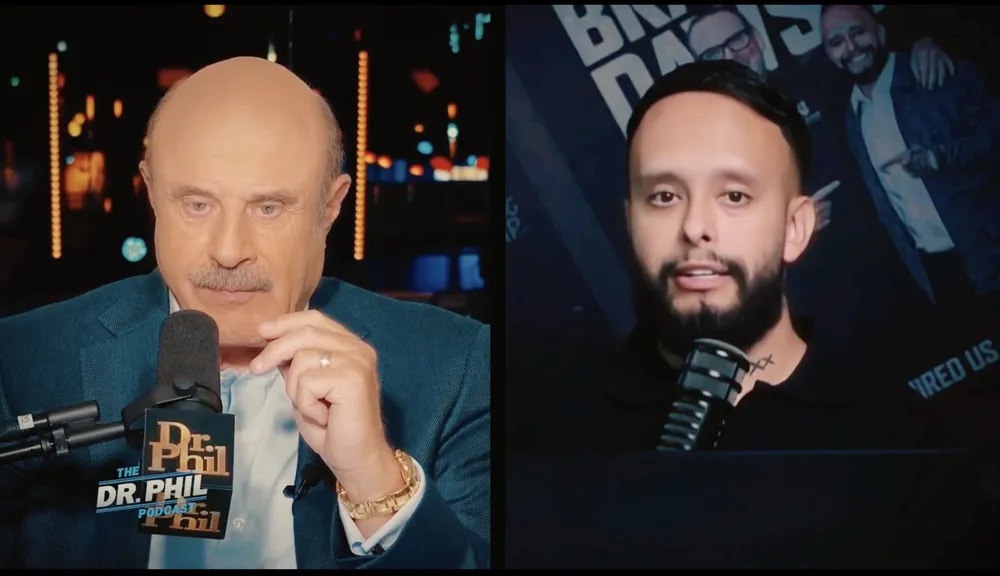
Sponsored content, bot farms, look-alike news sites and deepfake ads: what we covered on Episode 573 of The Dr. Phil Podcast, and how to spot a story that’s being pushed.
Quick answer
Most manufactured narratives use four tools: paid content that readers can’t tell apart from journalism, bot farms that fake public agreement, repetition across sites that look credible, and AI that puts real people’s faces and voices on things they never said. I walked through each one with Dr. Phil on Episode 573 of The Dr. Phil Podcast, “Media Psyops Exposed,” which aired September 24, 2025. The defense is simple to say and hard to practice: slow down, check who benefits, and look for the same wording everywhere.
Key facts
| Show | The Dr. Phil Podcast |
| Episode | Ep. 573, “Media Psyops Exposed: How Narratives Are Manufactured” |
| Aired | September 24, 2025 |
| Length | 45 minutes |
| Topics | Sponsored content, bot farms, look-alike news sites, AI deepfakes and fake ads, trust in media, growing an audience, media literacy |
| Watch | YouTube · Spotify |
What is a media psyop?
A psychological operation, where the motive and the method are hidden from the people it targets. Dr. Phil drew the line well on the show: openly trying to change someone’s mind is persuasion, and they can fact-check you. A psyop is when the audience doesn’t know it’s happening: one side is shown, things are made up, or bots make something look bigger than it is.
His point was that manipulation is not always insidious. If you tell someone up front that you want to change their mind and then show them your evidence, that is above board. What makes it a psyop is that nothing is disclosed. There is no transparency about who is behind it or how it works.
How did I learn how media manipulation works?
From inside the PR industry. Dr. Phil asked why I got into this work in the first place, and I gave him the honest answer: “I got into PR initially because I wanted the spotlight.” I first learned about PR at 17 or 18. Once I was working in the industry, I saw the good and the bad, including how easy some publications and newsrooms make it to manipulate what runs.
He then ran through my early press in Forbes, HuffPost, Inc. and Men’s Journal and asked a fair question: was I really achieving all of that, or was I manipulating the press to make them think I was? My answer: “At the time, I didn’t necessarily know how to manipulate the media at that point in time. So all of that was organic coverage.”
The early work came from a gap. “There was a lot of influencers on social media that had hundreds of thousands of followers to millions of followers, but they didn’t necessarily know how to get their story into the media.” Placing them was straightforward because “it’s a win-win, right? The media gets to publish them, they get eyeballs.”
Why do some stories get covered and others don’t?
Dr. Phil’s view from his own channel is that it always comes down to the content. He said nothing is done differently between a story that goes wide and one that doesn’t. It is whether the content connects with the audience.
My answer was that coverage depends on what one editor or producer happens to care about. “If you go out to the news outlets and they don’t care enough about the story, it doesn’t necessarily mean that the story doesn’t matter.” It means that person’s view of the story wasn’t strong enough to run it or interview someone about it. There are levers you can pull to get around that, and the most common one is paying.
How does sponsored content shape what you believe?
Many publications sell space. The piece runs on their site and looks like their journalism, but someone paid for it. As I said on the show, the public “doesn’t necessarily know the difference.” Most people don’t know you can pay these platforms to run content, and that those pieces are ads.
Only people who work in the industry, or who are a little more savvy, can tell a sponsored piece from an organic one. The issue I have with my own industry is that “a lot of the public doesn’t know how to necessarily discern what is sponsored and what not.” Readers assume the outlet approves of the person or the claim, when the outlet isn’t promoting that person at all. “It’s just a paid piece.”
Dr. Phil asked whether it works. It does, because paying skips the editors, and with them the judgment and the biases of the people who would normally decide what runs. “If you do something like a sponsored piece, you bypass all of that and you just pay the money to essentially get a story out there that you want to put out there.” It could be a business owner who wants to say he’s great at something, or anything else someone wants out there. Sponsored content isn’t wrong in itself. The problem is when readers can’t tell which is which.
Why doesn’t a retraction undo a false story?
Because the correction never reaches the people who saw the original. Outlets do retract stories that turn out to be inaccurate. “The issue with that is, millions of people have already seen the fake information.” They are not going to reread the article or go back to check whether a retraction was made. I called it an amplification loop: the false version spreads, and the fix doesn’t follow it.
How do bot farms push a narrative?
A bot farm is a network of fake accounts used to like, share and comment on something so it looks like real people agree. On the show I used the Blake Lively and Justin Baldoni case, where one of the PR people involved was alleged to have pushed a narrative this way on TikTok. “PR companies, not us, but other PR companies have this ability to have bot farms essentially push a narrative.” The accounts “make it seem like it’s done by real people with real thoughts and their real beliefs when it’s not.” Behind them is one company sending hundreds to thousands of bots.
What you see as a user is simple. “You see a comment and it has thousands of likes and you think that all those likes were done by real people when it’s actually not.”
It works because “not everybody wants to go against the grain.” If someone hasn’t made up their mind and sees thousands of people who seem to agree, they lean that way. And it isn’t limited to TikTok. “It’s on almost every platform.” It happens on Facebook and X too.
Dr. Phil added detail from his side. He said some farms identified in Russia control tens of thousands of accounts. The old tell was an account with no followers and no history. The better farms now run accounts with photos, histories and followers, so they look real until you check what they post and how often. He said that when you drill down, the same account puts out the identical message every 17 minutes on different platforms. Then real people jump on the bandwagon, and it can start a wave.
The people running these farms count on one thing. “They’re banking on people not doing their research.” That is a safe bet for them, because “a lot of us don’t have enough time to be independent journalists seeing if these are real or not.”
What are misinformation superspreaders?
A small number of accounts that drive most of the false content. Dr. Phil cited a study of tweets flagged for low credibility that found just 10 accounts were responsible for roughly a third of the misinformation, and 1,000 accounts for 70%. He said automated bot accounts are a major factor in amplifying it, because they artificially increase popularity and reach. The examples he gave included the COVID-19 pandemic and the financial sector, where this can move stock markets and investor behavior.
How does repetition make a fake story believable?
Seeing the same story on site after site that looks credible makes people assume it’s true. I gave the example of Russia’s “Doppelganger” campaign, which the U.S. Justice Department disrupted in 2024: it cloned real news sites and published false articles on them. As I put it on the show, “the repetition of seeing a credible news site with the same story over and over again, people are going to assume it’s true.”
This is also how I learned it firsthand. Years ago I placed a fabricated story about a 20-year-old selling a company for $100 million, believing it was real. Its sources were controlled by the person who made it up, so it checked out everywhere. As I said on the show, “I didn’t do it obviously on purpose.” The full account is on my story page.
How is AI being used to manipulate people?
Dr. Phil asked whether AI’s role in disinformation is overhyped. “No, I think it’s very real.”
The most common version right now is fake ads. Scammers use AI to copy a well-known person’s face or voice and have them endorse a product they’ve never heard of, often a supplement on TikTok. The example I gave was ads using a voice that sounds like Joe Rogan’s to promote a supplement nobody has heard of. People fall for it, and a lot of these people make a lot of money doing that.
Dr. Phil said it has happened to him: ads showing him holding products he had never seen, from supplements to hair growth products. Many are tied to a free trial. The ad says 90 days free, asks for a credit card, and starts billing after the trial. When people try to cancel, they can’t find the company. He said some of the people caught are elderly and on fixed incomes, billed $59.99 a month, which can decide whether they cover groceries, rent or utilities. He said they’ve done it with his wife too, and sometimes pair him with other recognizable people, some of them figures of authority.
It goes beyond ads. I described deepfake voices calling people’s parents, saying they have their kid and demanding ransom money. And it happens with articles: “people are pumping out so many fake AI articles that they obviously are not checking all of them.” AI gets things wrong, and those mistakes get published anyway. My summary: “I think it’s definitely not overhyped. I think it’s real. I think it’s scary. And I think we need to be more vigilant.”
Near the end, Dr. Phil said he has seen fakes of himself that he couldn’t tell weren’t him. The only clue was that the video looked too good. Sometimes it’s too clean.
What should you do if a fake celebrity ad is billing your card?
If you’ve been billed by one of those and can’t cancel, I gave two steps on air: “Call your bank. Ask them to do a chargeback on that exact thing. And then the second thing to do is ask for a stop payment.” The stop payment covers any charges from that company for that amount, “so that way you can get your money back and that way you can stop future payments.”
Dr. Phil explained why going after the companies rarely ends it. His team sends cease and desist letters, dozens in some months. When they get close, the company shuts down, reincorporates under a new name at a new post office box, and is back two days later.
How much do Americans trust the media?
Dr. Phil cited the numbers on air. A Gallup poll from February 2025 found 31% of Americans had a great deal or fair amount of confidence in the media to report the news accurately. For the third year in a row, more adults said they had no trust at all (36%) than said they had a great deal or fair amount. He cited Pew Research Center data showing only 26% of adults under 50 trust the media, compared with almost double that among people 65 and over. And nearly two-thirds of Americans say they experience news fatigue. His worry was that tuning out entirely may be even worse than distrust.
Who holds media outlets accountable when they get it wrong?
I told Dr. Phil I don’t know of any checks and balances that apply when an outlet knowingly pushes something false. He said the Department of Justice and the FCC have some leverage, but the real power is the checkbook. When viewers and advertisers say they’re offended and won’t listen, that sends the strongest message.
Where should you get your news?
Dr. Phil asked where people can find balanced news. It’s difficult today, because people have biases and beliefs, and that includes the people reporting. “The best thing to do is just try to get full context.” If you read a story, see what other people think about it.
The most common way people get misinformed is through short clips of what someone said. “They’re taking it out of context. They run with it and that’s all they do.” Most people don’t have time to look at the full thing. If you can, watch more of it, and don’t take everything at face value.
How do you grow an audience when the algorithm limits your reach?
Dr. Phil’s question: a client has a million followers, posts something, and the algorithm only shows it to 8,000 of them. How do you combat that?
I gave two answers. First, “they have to understand the platform they’re on. And most of these platforms prioritize entertainment over education.” If you accept that social media is more entertainment than information, you’ll do better. The catch is that entertainment doesn’t always translate into more sales or into the topics you actually want to talk about.
Second, collaborate. Major influencers and public figures do this all the time and feed off each other’s audiences, because “it’s very hard to essentially build an audience from scratch. But it’s much easier to go to somebody else’s audience that already has one.” You get a rub-off effect: that audience gets to see who you are, listen to you, and decide whether they like you and want to follow you. Building on social platforms with information alone is difficult, so you have to choose which platforms you build on.
How do you build a personal brand?
Dr. Phil asked what someone should do if they want to become an influencer or grow a modest audience. My answer: “one of the best ways to build an audience or build a personal brand is to go on shows like these, discuss your ideas and your beliefs and you will find people that value the same things as you do.”
Plenty of people won’t like what you have to say. That’s fine. You need to find more of the people who already believe what you believe. And “if you don’t, you can go on to shows and discuss your ideas and have them be challenged.” The short version: “go on shows, go where people have audiences, discuss your beliefs, discuss your ideas.”
Dr. Phil summed it up as finding people who co-sign you and collaborate with you, then asked what else you can do. Press: “getting into the media is also really great because it allows you to tap into that exposure.”
What is the downside of becoming a public figure?
I called it a double-edged sword. “The more and the bigger that you get, the more of a target you become, the more of a target your family becomes.” Growth doesn’t make everything easy. “You get almost an equal amount of force combating what you believe in and what you have to say.”
Not everyone has the resources to recover if something goes wrong, like losing a job. So it’s a real choice. “You do not have to combat any of this. You don’t have to challenge anyone’s ideas if you’re not in a position to” or don’t want the hassle.
How do you spot a story that’s being pushed?
- Look for the same wording everywhere. Real coverage varies. Identical phrasing across outlets and platforms is a red flag. Dr. Phil listed this with sensational headlines, single or anonymous sources, and too much outrage. In his words, if every platform has the same take, they don’t all see it the same way.
- Ask who benefits. On the show I put it this way: “who benefits from posting this, who benefits from the division?”
- Notice when a post is built to make you angry. “They’re trying to get most of the time people emotionally riled up about something so that way they can take action. So, just be safe. Guard what you believe.”
- Get the full context. Most misinformation spreads as short clips. Watch or read the whole thing before you decide.
- Check for a sponsored label. If a piece is paid, the outlet usually says so somewhere on the page.
- Check the accounts behind the agreement. Look at what they post and how often, not just how many followers they have. The same message posted every 17 minutes across platforms means nobody real is behind it.
- Be suspicious of video that looks too clean. Dr. Phil’s tell for deepfakes of himself was that they looked better than he does.
- Cross-check what matters. Dr. Phil’s advice was to build media literacy: think critically, cross-check information, and verify it with fact-checkers you trust before it shapes a decision. Just because you see it in print doesn’t mean it’s real.
- Assume you can be fooled. “Most people don’t think that they can be fooled. But I can guarantee you we all can and we all have been.”
FAQ
What is a media psyop?
A psychological operation in the media: an effort to shape what people believe where the motive and the method are hidden from the audience.
What is a bot farm?
A network of fake social media accounts, run by one operator, used to like, share and comment on content so a narrative looks like it has real public support.
How can you tell if a social media account is a bot?
Look past the follower count. Dr. Phil said sophisticated bot accounts now have stolen photos, fake histories, vacation and family pictures, and hundreds of followers. The tell is behavior: the same message posted again and again, every 17 minutes, across different platforms.
How can you tell if an article is sponsored?
Look for a label such as “sponsored,” “partner content” or “paid post,” usually near the headline or byline. If there’s no label and the piece reads like an ad, be cautious.
Is sponsored content the same as an ad?
Yes. Sponsored content means paying a publication to run a piece on its platform. As I said on the show, “obviously these are ads.” The outlet isn’t endorsing the person in it.
Why don’t corrections stop misinformation?
By the time a retraction runs, millions of people may have already seen the false version, and most of them never go back to check.
What should I do if a fake celebrity ad charged my card and I can’t cancel?
Call your bank and ask for a chargeback on that exact charge. Then ask for a stop payment, so future charges from that company for that amount are blocked.
How do AI voice scams work?
Scammers clone a voice with AI. In the ad version, a celebrity’s voice promotes a product they’ve never used. In the worst version, a cloned voice calls someone’s parents, says they have their child, and demands ransom money.
How do you grow on social media when the algorithm limits your reach?
Understand that most platforms reward entertainment over education, and collaborate with people who already have an audience. It’s much easier to reach someone else’s loyal audience than to build one from scratch.
What is the best way to build a personal brand?
Go on shows where people already have audiences and discuss your ideas and beliefs. You’ll find the people who value the same things you do, and getting into the media adds exposure on top of that.
What was Episode 573 of The Dr. Phil Podcast about?
“Media Psyops Exposed: How Narratives Are Manufactured” covered sponsored content, bot farms, look-alike news sites, AI deepfakes, and how to protect yourself from manipulation. It aired September 24, 2025.
How did Ulyses Osuna get booked on The Dr. Phil Podcast?
Through four pitches from his team over three months, followed by a call from the show four months later. The full story is in How I Got Booked on The Dr. Phil Podcast.
Work with us
Influencer Press places founders and creators in major publications, on TV, on podcasts, on Times Square billboards and on stages, and makes sure what search engines and AI say about them is accurate. If you want help with any of it, you can apply to work with Influencer Press.
About the author
Ulyses Osuna founded Influencer Press at 19 and has run it for nearly a decade, placing founders and creators in major outlets, on TV, on podcasts and on Times Square billboards. He has appeared on The Dr. Phil Podcast, been a panelist on Nasdaq TradeTalks, and spoke at Harvard Kennedy School in 2026. More: about, methodology, transparency.
More outlet guides
- How Helping an Entrepreneur.com Editor With Her Pet Brand Led to a 4-Part Video Series
- We Pitched 52 Media Contacts on Shakira’s World Cup Halftime Dancers. Here’s What Happened.
- How I Got Booked on The Dr. Phil Podcast: 4 Pitches, 200 Days, and One Phone Call
- What It Means to Be an Entrepreneur: The $5,000 Sponsored Video That Got 26,000 Views on Entrepreneur’s Facebook Page
- How I Almost Got a Speaking Slot at Relentless IV, the Event Kobe Bryant Headlined
- How I Got on Business Rockstars, My First TV Appearance, and Got My Clients on the Show
- How I Got on the Entrepreneur.com Homepage Through The Jeff Fenster Show
- How I Lived in a $29,500-a-Month Hollywood Hills Mansion for 30 Days in Exchange for PR